



Fortunately, making just three simple adjustments to your setup and swing can dramatically improve your chances of making clean contact and getting the ball safely towards the target.
These adjustments focus on three key areas:
-
Ball position
-
Club selection
-
Weight transfer
Let’s look at how each one can transform your fairway bunker play.
Why Fairway Bunker Shots Are Different
Before looking at the fixes, it’s important to understand why fairway bunker shots require a slightly different approach.
In a greenside bunker, the objective is to splash the sand and allow the sand to carry the ball onto the green. The club strikes the sand first, lifting the ball out softly.
In a fairway bunker, the goal is almost the opposite. You want minimal sand between the clubface and the ball. Ideally, the club should make clean contact with the ball first, just as it would from the fairway.
Because the ball is sitting on sand rather than grass, stability and balance become even more important. Any excess movement can lead to hitting the sand before the ball, which results in a heavy shot that often fails to travel far enough.
By making a few simple adjustments to your setup and swing, you can greatly increase your chances of producing a solid strike.
The Three Key Fixes
Ian Taylor recommends focusing on three reliable adjustments that remove much of the guesswork from fairway bunker shots:
-
Position the ball in the centre of your stance
-
Choose a stronger lofted club
-
Transfer your weight through to the target
Let’s break each of these down.

1. Ball Position: Place It in the Centre of Your Stance
Ball position plays a crucial role in achieving clean contact from a bunker.
For a fairway bunker shot, the ball should be positioned squarely in the middle of your feet.
This centred ball position helps the club approach the ball with a shallower angle, reducing the chance of digging into the sand before making contact.
When the ball sits too far back in your stance, the club tends to descend too steeply. This encourages the club to strike the sand first, which often results in a heavy shot that travels well short of the target.
On the other hand, placing the ball too far forward can make it difficult to control the strike and distance.
By keeping the ball directly in the middle of your stance, you give yourself the best chance of striking the ball cleanly and launching it out of the bunker with control.
2. Club Up: Choose a Stronger Loft
One of the most common mistakes golfers make in fairway bunkers is choosing too much loft.
Instinctively, many players reach for a high-lofted wedge, assuming it will help them lift the ball out of the sand. In reality, this often makes the shot more difficult.
Instead, Ian recommends “clubbing up”, choosing a lower-lofted club than you would normally use for that distance.
Using a stronger loft allows you to make a slightly fuller swing, which improves both contact and control.
For example, if you would normally play a three-quarter sand wedge from 80–90 yards, consider using a 52-degree gap wedge instead. The stronger loft helps promote a cleaner strike and gives the ball enough carry to clear the bunker edge and reach the green.
A fuller, more committed swing with the correct club often produces far better results than trying to manipulate a shorter swing with too much loft.
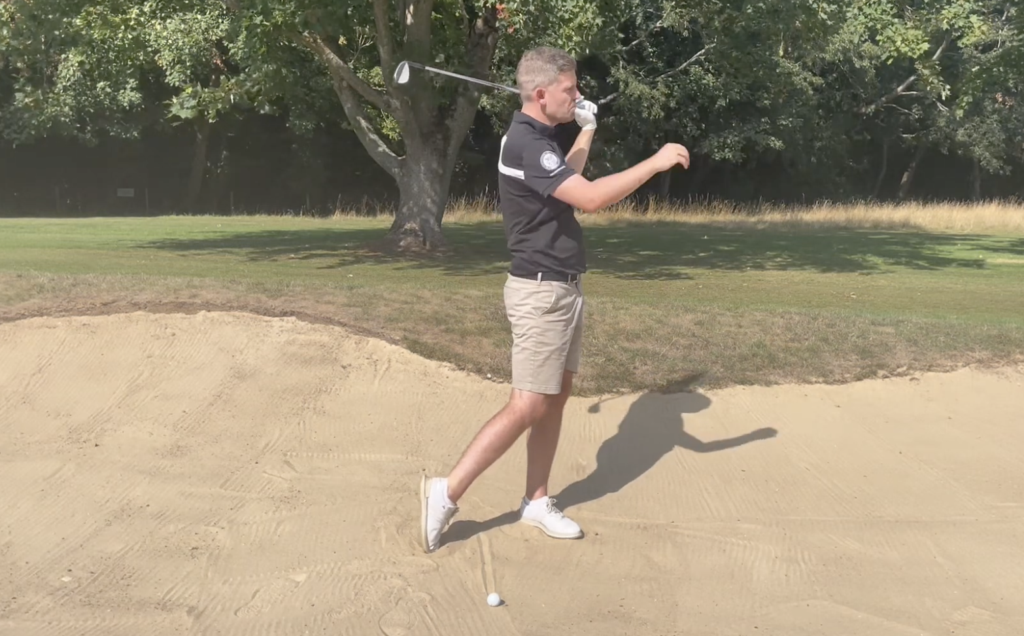
3. Transfer Your Weight Through to the Target
The final adjustment is the one many golfers overlook.
During the swing, it’s essential to move your weight through towards the target, finishing with your weight on your lead side.
Too many players try to help the ball into the air by leaning back or attempting to “lift” it out of the bunker. Unfortunately, this almost always causes the club to hit the sand first.
When your weight falls backwards, the low point of the swing moves behind the ball. The result is usually a heavy shot that stays in the bunker or comes up well short.
Instead, focus on rotating your hips, chest and shoulders towards the target, allowing your weight to move forward as you swing through the ball.
By the time you finish the swing, you should feel your weight balanced on your front side, with your trail foot beginning to release from the ground.
This forward motion helps ensure the club strikes the ball first, producing the clean contact you need.
A Simple Fairway Bunker Setup Checklist
Next time you find your ball in a fairway bunker, run through this quick setup routine:
Stance
Take a slightly narrower stance than you would for a normal iron shot, with the ball positioned in the middle of your feet.
Grip and Posture
Maintain your normal grip and athletic posture. Keep your balance centred and stable.
Club Selection
Choose one or even two clubs more than you might normally use from that distance.
Weight Movement
Start balanced and commit to transferring your weight through the shot towards the target.
Mental Focus
Think about striking the ball cleanly rather than trying to scoop it out of the sand.
Common Mistakes to Avoid
Even small errors can make fairway bunker shots difficult. Here are three mistakes to watch out for.
Ball Too Far Back
This often causes the club to dig into the sand before the ball. Move the ball back to the centre of your stance.
Too Much Loft
Using a high-lofted wedge can reduce carry distance and make the strike inconsistent. Try a stronger loft instead.
Weight Staying Back
Failing to move your weight forward leads to sand-first contact. Focus on finishing with your weight on your lead side.

A Simple Practice Drill
To build confidence with these adjustments, try this straightforward practice drill.
Start by placing a ball on short grass or in a shallow practice bunker. Choose the club you would normally use for a fairway bunker shot.
Make a few practice swings focusing purely on moving your hips and chest towards the target. Exaggerate the weight shift so that you clearly finish on your lead side.
Once the movement feels natural, begin hitting shots while maintaining the same feeling.
The goal is to develop a consistent motion where the club strikes the ball first and your body continues through the shot.
Turning a Difficult Shot into a Scoring Opportunity
Fairway bunkers will always require a little extra attention, but they don’t need to ruin your hole.
By remembering three simple principles:
-
Ball in the middle of your stance
-
Club up to ensure enough carry
-
Transfer your weight through the shot
you can greatly increase your chances of producing a solid strike.
With a clear setup, the right club, and a committed swing, fairway bunkers become far less intimidating and may even become another opportunity to hit the green and keep your score moving in the right direction.
About Your Coach
Ian Taylor has nearly 20 years experience as a PGA Professional. Ian specialises in helping golfers struggling to break 100 on the course! His guidance has helped hundreds of golfers save shots on the course and see their scores consistently lower. He is based at East Herts Golf Club near Buntingford, UK.